How to Build a Signature Style as a Man (Step-by-Step Guide)

A signature style is built by narrowing down — not adding more.
Pick a handful of fits, colors, and details you repeat on purpose until people recognize them as “your thing,” then get ruthless about cutting anything that doesn’t reinforce that look.

It takes weeks of small decisions, not one big shopping trip, and this guide walks through exactly how to do it.
What Does “Signature Style” Actually Mean?
Signature style isn’t a uniform and it isn’t a personality trait you’re born with. It’s a repeatable set of choices — silhouette, color palette, a couple of consistent details — that you make often enough that they start to look intentional instead of random.
Think about the men whose style you actually recognize at a glance: they’re not wearing something different every day.
They’re wearing variations of the same few ideas. That’s the entire trick, and it’s learnable.

Most men who say they “don’t have style” actually have the opposite problem — too many competing ideas fighting each other in the closet.
A gym-fit hoodie next to a slim Italian blazer next to a pair of relaxed dad jeans next to skinny chinos.
None of it is wrong individually, but none of it reinforces a single point of view either. Building a signature style means picking a lane and getting good at it before you branch out.
Read also: Weekend Outfit Ideas for Men: Comfortable Yet Stylish
Step 1: Audit What You Already Own (And What You Actually Wear)
Before buying anything new, go through your closet and separate it into three piles: what you wear constantly, what you wear occasionally, and what hasn’t touched your body in six months.
That first pile is your real signature style already — it’s just been hiding as “whatever’s clean.” Look for patterns: Do you keep reaching for the same three colors? The same silhouette? The same brand’s cut?
This step matters because most men skip straight to “I need new clothes” when the real problem is clarity, not inventory. You likely already have signals pointing toward your style — you just haven’t paid attention to them yet.
Practical exercise: lay out the ten outfits you’ve worn most in the last month. Photograph them. Look for the repeated thread — is it always slim through the leg? Always earth tones? Always a jacket, even in summer? That thread is your starting point.
Step 2: Know Your Body Type Before You Choose a Direction
Signature style only works when it fits you — literally. A boxy, oversized silhouette reads as intentional on a tall, lean frame and can look sloppy on a shorter, stockier one. This isn’t about restriction; it’s about knowing which proportions flatter your build so your “signature” reads as confident rather than accidental.
- Broader or heavier build: structured shoulders, mid-rise trousers, vertical lines (unbuttoned layers, longer jackets) tend to elongate.
- Slim or lean build: slightly looser cuts, textured fabrics, and layering add dimension without swallowing the frame.
- Shorter frame: higher rise trousers, shorter jacket lengths, and cuffs that break right at the shoe keep proportions clean.
- Taller frame: you can handle more oversized pieces and bolder proportions without looking overwhelmed.
Once you know your proportions, you can commit to a silhouette instead of guessing every time you get dressed.
Step 3: Pick Two or Three Anchor Elements to Repeat on Purpose
This is the actual mechanism of signature style: choosing a small number of elements you repeat until they become recognizable. It could be a silhouette (always a slightly cropped trouser), a color story (navy, camel, and white, nothing else), a single accessory (the same watch or ring every day), or a detail (always rolled sleeves, always a popped collar, always the same boot).
Pick no more than three. More than that and you’re back to the “no clear point of view” problem. Fewer than that and it might read as coincidence rather than style. Three is the number that feels deliberate without feeling like a costume.
Good anchor combinations look like:
- Slim tailoring + earth tones + one signature accessory (a bracelet, a specific watch)
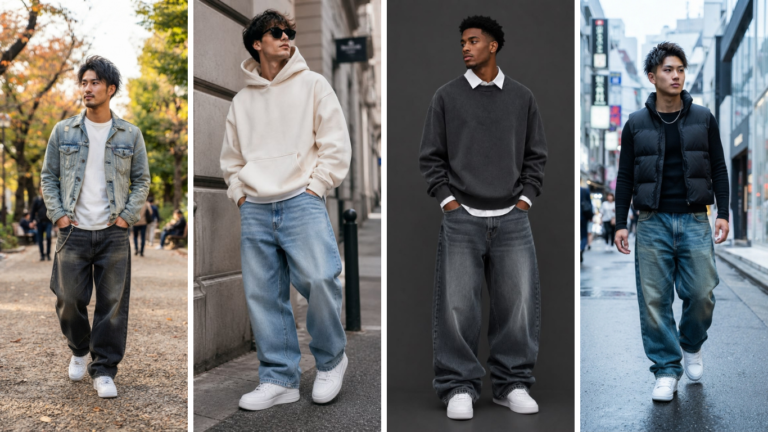
- Oversized fits + monochrome palettes + statement footwear
- Classic prep silhouette + navy/white/burgundy + always a knit layer
Read also: 50 Best Dressed Men to Follow for Style Inspiration in 2026
Step 4: Build a Color Palette You Can Repeat Without Getting Bored
Color is the fastest way to make a wardrobe feel cohesive, and it’s the easiest thing to get wrong by overcorrecting. Pick a base of two neutrals (navy and gray, or black and camel) and one accent color you genuinely like wearing (burgundy, olive, a specific blue). Every piece you buy going forward should work with at least two of those three colors.
This does two things. First, it means everything in your closet mixes with everything else — no more “I have nothing to wear with this” pieces sitting unused. Second, it trains other people’s eyes to associate that palette with you specifically, which is the actual definition of a signature look.
If you’re not sure where to start, look at your skin tone and what you already gravitate toward in Step 1. Most men land in one of three lanes: warm neutrals (camel, olive, cream), cool neutrals (navy, charcoal, white), or a high-contrast palette (black, white, one bold accent). Pick one and stop shopping outside it for at least six months.
Step 5: Invest in Fewer, Better Pieces Instead of Chasing Trends
A signature style is expensive to build if you’re buying trend pieces every season, because trend pieces have a shelf life and your signature shouldn’t. Instead, put your budget toward a small number of higher-quality pieces that match your anchor elements from Step 3 and your palette from Step 4.
This usually means: one exceptional jacket over three mediocre ones, boots that get resoled instead of replaced, and a couple of shirts or knits in your core colors that fit exactly right rather than a drawer full of “close enough.” Fit and fabric quality do more to make a look feel signature than logos or trend pieces ever will — a well-fitted plain T-shirt in the right color reads more intentional than an ill-fitting graphic tee from this season’s drop.
Trends are fine to dip into occasionally, but they should sit on top of your established base, not replace it. If a trend piece doesn’t work with your existing palette or silhouette, skip it — it’s not worth breaking the pattern you’ve built.
Step 6: Refine Through Repetition, Not Reinvention
Signature style isn’t a one-time decision — it’s refined by wearing the same few ideas repeatedly and noticing what works. Give yourself a season (roughly three months) of sticking to your chosen silhouette, palette, and anchor pieces before making any major changes.
You’ll notice small adjustments naturally: maybe the cropped trouser works better with boots than sneakers, maybe the accent color you picked doesn’t get worn as much as you thought it would.
This is also where confidence comes in. The first few weeks of deliberately repeating a look can feel exposing — like people will notice you’re “always wearing the same thing.” They will notice, and that’s the point.
Recognizability is the entire goal of a signature style. The men whose style people remember aren’t the ones who dressed differently every day; they’re the ones whose choices became familiar enough to be associated with them specifically.
Do This / Not That: Building a Signature Style
| Do This | Not That |
|---|---|
| Repeat 2-3 anchor elements deliberately | Change your entire look every week |
| Build around a tight, 2-3 color palette | Buy whatever color catches your eye that day |
| Invest in fewer, well-fitted pieces | Chase every microtrend on your feed |
| Get key pieces tailored to your body type | Wear straight-off-the-rack fits regardless of proportion |
| Give a look a full season before judging it | Abandon a direction after one underwhelming outfit |
| Let a signature piece (watch, boot, jacket) become recognizable | Rotate accessories so nothing ever repeats |
Common Mistakes Men Make When Trying to Build a Signature Style
- Confusing “more variety” with “better style.” A closet full of unrelated pieces isn’t versatile — it’s directionless. Fewer, connected pieces will always look more intentional.
- Copying someone else’s signature wholesale. Borrowing inspiration is smart; copying a specific person’s exact look usually falls flat because it wasn’t built around your body type or lifestyle.
- Skipping tailoring. A repeated silhouette only reads as a “signature” if it actually fits. An off-the-rack jacket that’s slightly too big undercuts everything else you’re doing.
- Changing direction too fast. Committing to a style takes longer than a week. Give any real change at least a season before deciding it’s not working.
- Ignoring grooming and fit as part of the “look.” Style isn’t just the clothes — a consistent haircut, beard length, or grooming routine is often part of what makes a look feel signature.
- Over-accessorizing to compensate for a weak base. If the core silhouette and palette aren’t working, more jewelry or accessories won’t fix it — they’ll just add noise.
How to Know If Your Signature Style Is Actually Working
There are a few honest signals that tell you whether the direction you’ve picked is landing, versus just feeling like a phase. First, notice whether getting dressed has gotten faster.
A working signature style removes decision fatigue — you’re choosing from a small pool of pieces that all work together, so mornings stop involving twenty minutes of second-guessing.
If you’re still standing in front of the closet unsure what goes with what, the palette or silhouette you picked probably isn’t tight enough yet.
Second, pay attention to unprompted comments. Not compliments on a single outfit — those happen regardless of whether you have a signature style — but comments that reference a pattern: “that’s such a you jacket,” or “I knew that was your car before I saw you get out of it” energy applied to clothing.
That kind of recognition only shows up once you’ve repeated something enough times for it to register.
Third, check whether your “occasional wear” pile from Step 1 is shrinking over time. As your signature style solidifies, fewer pieces should end up in the rarely-worn category, because everything you own is built to work within the same system.
If that pile keeps growing instead of shrinking, you’re likely still buying pieces that don’t reinforce your core silhouette or palette — which is a sign to revisit Steps 3 and 4 before adding anything new to the rotation.
FAQ
How long does it take to build a signature style? Most men see a noticeable shift within one to three months of deliberately repeating the same silhouette, color palette, and anchor pieces. A fully “recognizable” signature style — one other people comment on — usually takes closer to six months of consistent choices.
Do I need to spend a lot of money to build a signature style? No. A signature style is more about repetition and consistency than price point. A tightly edited wardrobe of affordable, well-fitted pieces in a repeated palette will always read as more intentional than an expensive wardrobe with no throughline.
Can my signature style change over time? Yes, and it should evolve as your body, career, and taste change. The goal isn’t to lock in one look forever — it’s to always have a clear, consistent point of view at any given time rather than dressing randomly.
What’s the easiest way to start if I have no idea what my style is? Start with Step 1: audit what you already wear most and look for the repeated thread. Most men already have the beginnings of a signature style sitting in their closet — they’ve just never isolated it on purpose.
Read also: