How to Measure Shoe Size at Home: A Step-by-Step Guide for Men
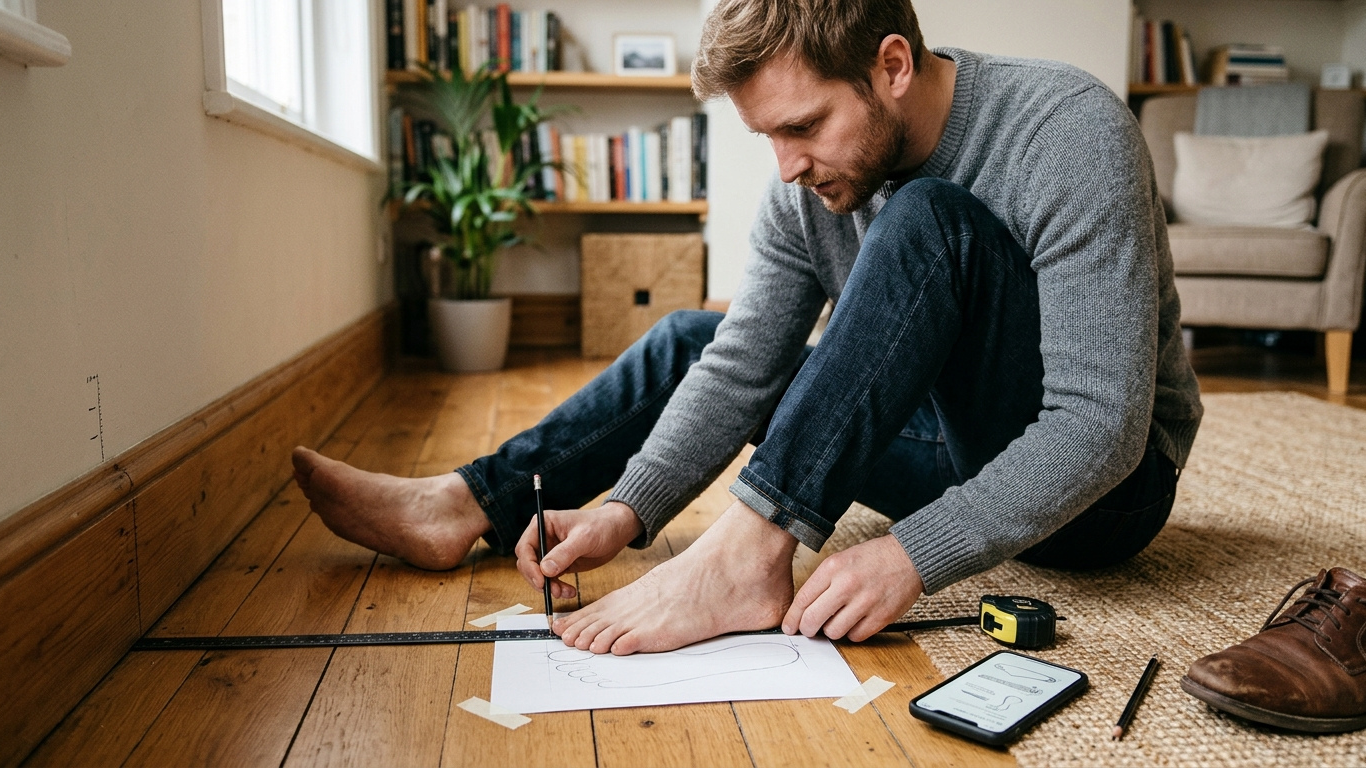
You can measure your shoe size at home with a sheet of paper, a pencil, and a ruler or tape measure.
Trace or mark your foot while standing, measure from the back of your heel to the tip of your longest toe, then compare that number with the sizing chart of the brand you plan to buy.
The whole process takes about five minutes, and it is the most reliable way to stop ordering shoes that turn out too tight, too loose, or too narrow.
Many men rely on a size they settled on years ago. But feet can change with age, weight, activity, and footwear habits, and a “10” in one brand is not always a “10” in another.
This guide shows you how to measure your feet for shoes accurately, how to measure width, how to read a foot measurement chart, and what to do when your numbers fall between sizes.
What You Need Before You Start
Gather these items:

- A blank sheet of paper larger than your foot (A4 or letter size works for most men)
- A pencil or fine-tip pen (a pen is more precise than a marker)
- A ruler or flexible tape measure with both centimeters and inches
- Masking tape to hold the paper in place
- A hard, flat floor and a straight wall
- The type of socks you usually wear with the shoes you are buying
A helper makes the process more accurate, because it is difficult to mark your own toe position while standing with your weight on the foot. If you are alone, you can still get a good result by working slowly and checking your marks.
When to Measure Your Feet
Feet tend to swell slightly through the day, especially after walking or standing.
Measuring in the late afternoon or evening gives you a more realistic number for shoes you will wear all day.
Measuring first thing in the morning can leave you with a size that feels fine at first but gets tight by evening.
Plan to measure both feet. It is common for one foot to be slightly longer or wider than the other, and the larger foot should guide your choice.
How to Measure Foot Length at Home
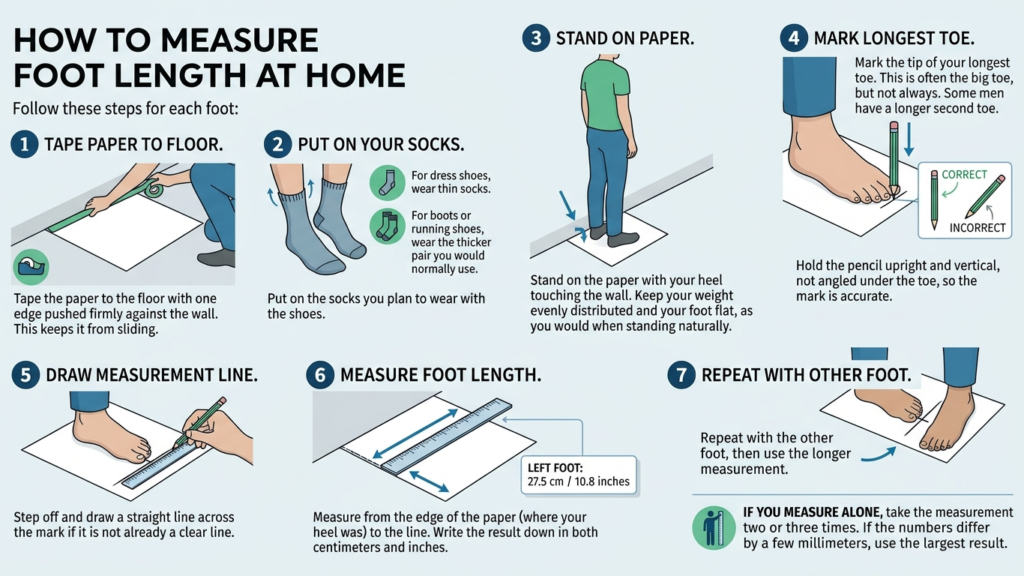
Follow these steps for each foot:
- Tape the paper to the floor with one edge pushed firmly against the wall. This keeps it from sliding.
- Put on the socks you plan to wear with the shoes. For dress shoes, wear thin socks. For boots or running shoes, wear the thicker pair you would normally use.
- Stand on the paper with your heel touching the wall. Keep your weight evenly distributed and your foot flat, as you would when standing naturally.
- Mark the tip of your longest toe. This is often the big toe, but not always. Some men have a longer second toe. Hold the pencil upright and vertical, not angled under the toe, so the mark is accurate.
- Step off and draw a straight line across the mark if it is not already a clear line.
- Measure from the edge of the paper (where your heel was) to the line. Write the result down in both centimeters and inches.
- Repeat with the other foot, then use the longer measurement.
If you measure alone, take the measurement two or three times. If the numbers differ by a few millimeters, use the largest result.
Alternative: The Tracing Method
If you prefer to trace your foot:
- Stand on the paper and have someone draw around the outline of your foot, holding the pencil straight and close to your foot.
- Draw a straight line touching the back of the heel and another touching the front of the longest toe.
- Measure the distance between the two lines.
Tracing also shows the overall shape of your foot, which helps when you are trying to decide between a narrow and a wide shoe.
How to Measure Foot Width
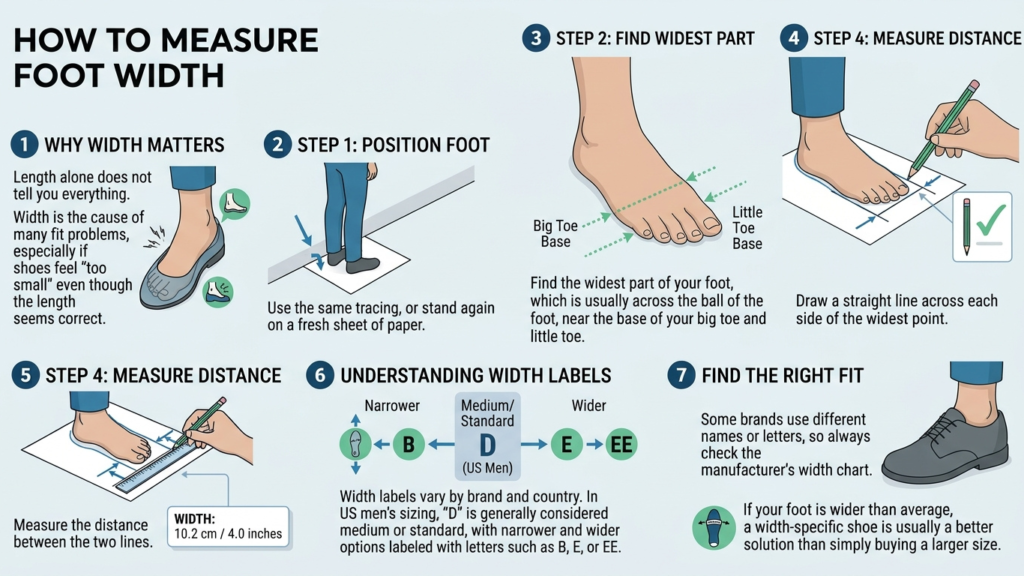
Length alone does not tell you everything. Width is the cause of many fit problems, especially if shoes feel “too small” even though the length seems correct.
- Use the same tracing, or stand again on a fresh sheet of paper.
- Find the widest part of your foot, which is usually across the ball of the foot, near the base of your big toe and little toe.
- Draw a straight line across each side of the widest point.
- Measure the distance between the two lines.
Width labels vary by brand and country. In US men’s sizing, “D” is generally considered medium or standard, with narrower and wider options labeled with letters such as B, E, or EE. Some brands use different names or letters, so always check the manufacturer’s width chart. If your foot is wider than average, a width-specific shoe is usually a better solution than simply buying a longer size.
How to Read a Shoe Size Chart
Once you have your foot length, compare it with a brand’s size chart. A chart typically lists foot length alongside US, UK, and EU sizes.
Below is an example for US men’s sizes 8 to 12, based on one retailer’s published guide. Treat it as an approximate reference rather than a universal standard.
| US | UK | EU | Foot Length (cm) | Foot Length (in) |
|---|---|---|---|---|
| 8 | 7 | 41 | 25.4 | 10.00 |
| 9 | 8 | 42 | 26.3 | 10.35 |
| 10 | 9 | 43 | 27.2 | 10.71 |
| 11 | 10 | 44 | 28.1 | 11.06 |
| 12 | 11 | 45 | 29.0 | 11.42 |
Why Charts Don’t Always Agree
Shoe sizing is not standardized worldwide, and brands use different lasts (the foot-shaped forms that shoes are built around). You can see this by comparing charts.
One outdoor-footwear brand lists foot lengths of about 25.1 to 25.7 cm for a US 8, while a running brand lists 26 cm for the same US size. Some brands also print a centimeter size on the box that does not equal your actual foot length.
Nike, for example, notes that the CM size on its shoe boxes and labels is different from foot length.
This means two things:
- Always use the chart from the brand you are buying, not a generic one.
- Treat any conversion as a starting point, and read the brand’s fit notes or reviews before ordering.
Quick Conversion Rules of Thumb
These rough relationships hold for many men’s shoes, though exceptions exist:
- A US men’s size is commonly about one size higher than the UK size (for example, US 10 is about UK 9).
- EU sizes use a different scale and do not map perfectly to US or UK sizes, so use a chart rather than guessing.
What to Do If You Fall Between Sizes
It is common for a measurement to land between two sizes on a chart. Use these guidelines:
- For most shoes, size up. Your foot needs room in front of the toes, and shoes that are too short cannot be fixed.
- For narrow feet, consider the smaller size only if the brand offers a narrow width or you will wear thick socks and the shoe has a secure lacing system.
- For leather dress shoes, a snug but not painful fit can work, since leather stretches slightly over time. Do not count on it for tight toes.
- For athletic and running shoes, leave extra space. Running brands often recommend roughly a thumb’s width in front of the longest toe, because feet expand during activity.
- For shoes worn with orthotics, measure with the insoles you will actually use and choose a shoe with a removable footbed and adequate depth.
Read also: How to Find Your Correct Shoe Size: A Practical Guide for Men
How Much Room Should You Have at the Toe?
After you choose a size, the fit check is simple. When you stand, there should be about a thumb’s width (around 1 cm or 3/8 inch) between your longest toe and the end of the shoe. Your toes should be able to move without pressing against the front or top, and your heel should be held firmly with only slight movement.
Foot length is the starting point, but the number on the ruler is not the same as the shoe size. Shoes are made slightly longer than the foot they are designed for, which is why the toe allowance exists.
Common Mistakes When Measuring Your Feet
- Measuring while sitting. Your foot spreads and lengthens when weight is on it. Always measure standing.
- Measuring only one foot. Differences between feet are normal, and you need the larger measurement.
- Ignoring width. A correct length with a wrong width will still be uncomfortable.
- Letting your heel drift off the wall. Even a few millimeters can shift the result.
- Tilting the pencil. An angled pencil under the toe makes the foot seem shorter or longer than it is.
- Using an old size. Re-measure every year or two, and after significant weight change, injury, or long periods of different activity.
- Assuming all brands fit the same. Always check the chart and read fit comments from other buyers.
Other Ways to Check Your Size
Measuring at home is accurate enough for most purchases, but you can combine it with other methods:
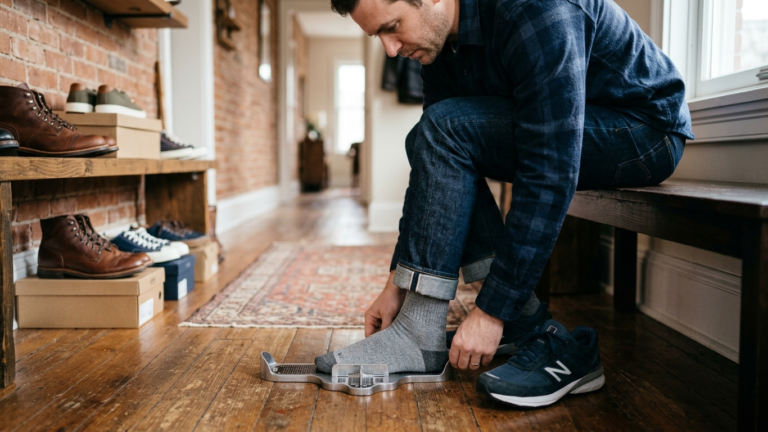
- Use a Brannock device at a shoe store. This metal measuring tool is a standard in many shoe stores and measures length, arch length, and width.
- Compare against a pair that fits well. Measure the insole of a comfortable shoe and compare it with the brand’s chart, remembering that this only works if that shoe fits well and is similar in style.
- Visit a specialist running or footwear store if you have unusual foot shape, pain, or a need for orthotics. If you have persistent foot pain, a podiatrist can offer advice that goes beyond sizing.
Tips for Using Your Measurements When Shopping Online
- Write down your length and width in both centimeters and inches so you can use any brand’s chart.
- Find the brand’s size chart on the product page and match your longest foot measurement to its foot-length column.
- Read fit reviews for notes such as “runs small,” “narrow,” or “roomy.”
- Check the return policy, including who pays for return shipping and how long you have.
- Try shoes on indoors, on a clean surface, so you can still return them if they do not fit.
Final Takeaways
To measure your shoe size at home accurately, measure both feet standing, in the evening, wearing the socks you plan to use.
Take the longer foot length from heel to longest toe, measure the widest part of the foot, and use the brand’s own size chart instead of a generic conversion.
If you fall between sizes, lean toward the larger one for comfort, and always check that you have about a thumb’s width of space at the toe.
Re-measure your feet every year or two. A few minutes with paper and a ruler will help you buy shoes that fit properly the first time.
Read also: