Leather vs Synthetic Shoes: Which Is Better for Men?

For most men who want shoes that last, breathe, and age well, good-quality leather is the better choice.
Synthetic shoes win on price, low maintenance, water resistance, and animal-free materials, and in athletic footwear they are often the right material.
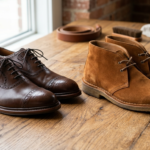
The real answer depends on what you are buying, how you will wear it, and which grade of leather or type of synthetic you are actually getting.
That last point trips up many buyers.
The labels “genuine leather” and “synthetic leather” sound like opposites, but the gap between a well-made leather shoe and a cheap one can be as wide as the gap between leather and plastic.
This guide explains what each material is, how they compare on durability, comfort, care, and cost, and how to choose between them.

What Is Leather, and What Does “Genuine Leather” Actually Mean?
Leather is animal hide, usually cowhide, that has been tanned so it will not rot and stays flexible. How good the finished material is depends heavily on which part of the hide it comes from and how it is processed. The commonly used grades, from highest to lowest quality, are:
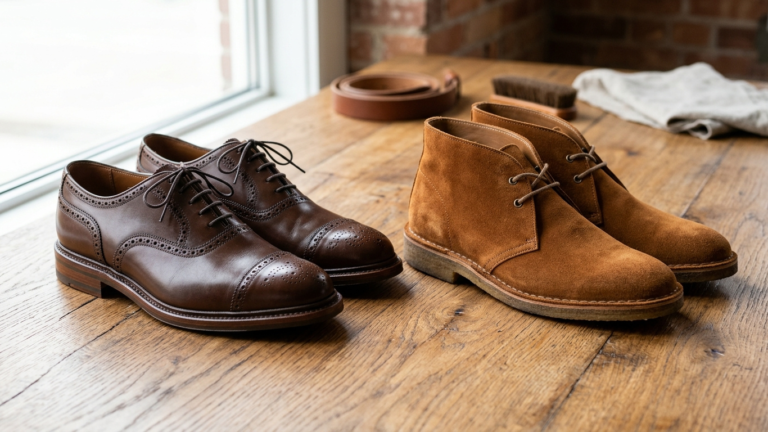
- Full-grain leather: Uses the outermost layer of the hide with the grain left intact, including natural marks. It is dense, strong, breathable, and develops a patina with age. It is typically found in higher-quality dress shoes and boots.
- Top-grain leather: The top layer, lightly sanded or buffed to remove blemishes. It has a smoother, more uniform look and is still durable, though generally considered slightly less tough than full-grain.
- Split or “genuine” leather: Made from the lower layers of the hide after the top layer is separated. It is real leather but a lower grade, and is often coated or embossed to imitate a higher grade.
- Bonded leather: Leather scraps and fibers combined with adhesives and backing. It is rarely used in quality footwear.
Here is the catch. “Genuine leather” on a label technically means real animal hide, but in practice it often signals a lower grade than full-grain or top-grain.
There is no single universal grading system, and some sellers use the term loosely, so it is worth looking for the specific grade in the product description.
If a brand only says “genuine leather,” it may be using a split leather, and the price and construction can help you judge.
What Is Synthetic Leather?
Synthetic leather, also called faux leather, leatherette, or “vegan leather,” is a man-made material. Most commonly it is a fabric backing coated with polyurethane (PU) or polyvinyl chloride (PVC), embossed with a leather-like grain.
Some products are labeled as plant-based or bio-based, but these still usually include a polymer coating.
Two points are worth knowing:
- Not all “synthetic” shoes are the same. A cheap coated-PU dress shoe is very different from the engineered mesh or microfiber uppers used in running shoes. Athletic synthetics are designed for light weight, flexibility, and ventilation, and they perform well in that role.
- Some products blur the line. Certain “PU leather” or “bicast” products use a split leather base with a polyurethane coating on top. They contain real leather but behave more like a coated synthetic and are prone to the same surface wear.
Leather vs Synthetic Shoes at a Glance
| Factor | Quality leather | Synthetic |
|---|---|---|
| Durability | Strong and long-lasting when cared for. Wear mostly shows as creasing and scuffs. | Varies widely. Coated PU or PVC can peel or crack over time, especially at flex points. |
| Breathability | Porous, allows moisture vapor to pass. | Coated synthetics breathe poorly. Mesh and knit synthetics can breathe very well. |
| Comfort and fit | Molds to the foot with wear. | Often stays stiffer and does not mold the same way. Soft synthetics can feel comfortable from day one. |
| Water resistance | Not waterproof unless treated. Can stain and stiffen if soaked and dried badly. | Often resists water and wipes clean easily. |
| Maintenance | Needs cleaning and conditioning. | Minimal. Wipe clean. |
| Repairability | Many well-made leather shoes can be resoled and refreshed. | Often glued construction that is harder to repair. |
| Aging | Develops patina and character. | Tends to look worn rather than seasoned. |
| Price | Higher upfront. | Lower upfront. |
| Animal-free | No. | Yes, for fully synthetic products. |
Leather Shoe Advantages
Durability and the way leather ages
Well-made leather is built from a fibrous material that can flex thousands of times without falling apart. When it does show age, it usually does so gradually: creases at the toe flex, scuffs that can be polished out, and a deepening color. This is why full-grain leather dress shoes and boots are often kept for many years, with their owners refreshing them rather than replacing them.
Breathability and comfort
Leather has a natural porous structure that allows some air and moisture vapor to move through the upper. This helps keep feet drier over a long day than a coated plastic surface, which tends to trap heat and moisture. Leather also softens and conforms to the shape of your foot with wear, which is why a good pair becomes more comfortable after a short wear-in period. [internal link: how to break in leather shoes]
Repairability
Quality leather shoes, particularly those with stitched constructions such as Goodyear-welted or Blake-stitched soles, can often be resoled, polished, and repaired by a cobbler. That extends their life and lowers the cost per wear. Cheaper glued constructions limit repair options, whatever the upper material.
Style and formality
For business, formal, and smart-casual outfits, leather has an established look that synthetic imitations often struggle to match, especially up close. Real grain, natural variation, and the way leather takes polish are hard to fake.
Synthetic Footwear: Where It Makes Sense
Price
Synthetic shoes are usually cheaper. If you need an inexpensive pair for a short-term purpose, such as a job you may leave soon or a one-off event, that can be a practical choice.
Low maintenance and weather performance
A coated synthetic surface can be wiped clean and often handles rain and splashes without special care. That is convenient for commuting, wet climates, and workplaces where shoes get dirty.
Athletic and technical uses
Running shoes, training shoes, and many casual sneakers use engineered synthetic uppers because they are lightweight, flexible, and breathable in the right areas. For sports and gym use, synthetics are often a better fit than leather.
Animal-free preference
If you avoid animal products, fully synthetic shoes are the straightforward option. If that matters to you, check the product description, because some products labeled as vegan or eco-friendly still contain mixed materials.
Read also: How to Measure Shoe Size at Home: A Step-by-Step Guide for Men
Synthetic Shoe Durability: What to Expect
Durability is the biggest drawback of cheap synthetic dress shoes. Coated materials such as polyurethane can degrade through hydrolysis, a chemical reaction with moisture that breaks down the coating.
Over time, the surface may peel, flake, or crack, usually at the points that bend most, such as the toe crease. Once the coating separates from the backing, it generally cannot be repaired.
How soon this happens depends on the quality of the material, how often the shoes are worn, climate, and storage. Some sources quote timeframes, but they vary widely and are not guarantees. A better question to ask is whether the shoe is made for hard daily wear or occasional use.
There are exceptions. Well-engineered synthetic uppers in athletic or work shoes are designed to withstand heavy use, and they can last well. The warning applies mainly to inexpensive coated imitation leather in dress and casual shoes, where peeling and cracking are common complaints.
Common Problems With Each Material
Leather:
- Can dry out and crack if never conditioned
- Can stain or stiffen if soaked and dried near heat
- Needs time to break in
- Lower grades can have coatings that peel, much like synthetics
Synthetic:
- Poor breathability in coated styles, leading to sweaty feet and odor
- Surface peeling and cracking
- Limited repair options
- Often does not mold to the foot over time
Read also: How to Find Your Correct Shoe Size: A Practical Guide for Men
How to Tell What a Shoe Is Made Of
Labels can be vague, so combine several clues:
- Read the product description and label. Look for terms such as full-grain, top-grain, or “man-made material.” “Genuine leather” alone is less informative.
- Look at the surface. Real leather has small irregularities in the grain. A perfectly uniform, repeating pattern can suggest embossing or a synthetic surface.
- Check the edges and inside. Real leather has a fibrous, suede-like underside. Synthetics often show a fabric or plastic backing.
- Press and flex it. Real leather creates fine wrinkles that vary. Plastic coatings tend to form sharper, more uniform folds.
- Consider the price and construction. A very low price for a “full-grain leather” shoe is a warning sign, and so are glued soles on a shoe marketed as premium.
No single test is conclusive. The smell test is often mentioned, but a leather scent can be added to synthetics, so do not rely on it alone.
How to Choose Between Leather and Synthetic Shoes
Use the situation to decide:
- Formal or work shoes worn often: Choose full-grain or top-grain leather with a repairable sole.
- Everyday casual shoes: Quality leather is a good long-term choice, but well-made synthetic or mixed-material sneakers are practical and widely used.
- Running and gym: Choose purpose-built synthetic or mesh footwear.
- Rainy or messy conditions: Treated leather or a water-resistant synthetic both work. Choose based on the shoe’s design and how much care you will give it.
- Tight budget: Consider a lower-cost leather shoe over a similarly priced coated synthetic, or choose a well-reviewed synthetic made for the purpose. Avoid paying a premium for a product that is labeled leather but is a heavily coated split.
- Animal-free preference: Choose clearly labeled fully synthetic or plant-based options and check how they are constructed.
Fit matters whichever you choose. A well-made shoe in the wrong size will hurt, so see how should shoes fit before you buy.
Caring for Each Type
Leather
- Brush off dirt after wearing.
- Clean with a damp cloth and a leather-appropriate cleaner when needed.
- Condition periodically so the leather does not dry out.
- Use cedar shoe trees to absorb moisture and hold the shape.
- Rotate pairs, giving each a day to dry between wears.
- If wet, let them dry at room temperature, away from radiators and direct heat.
Synthetic
- Wipe with a damp cloth and mild soap.
- Avoid harsh solvents and high heat, which can damage coatings.
- Store them in a cool, dry place with some airflow, since coated materials can degrade if stored damp.
- Replace them when the coating begins to peel, because the damage usually spreads.
A Note on Environmental Concerns
The environmental comparison is contested.
Leather is a byproduct of the meat industry, and tanning uses chemicals and water, with impacts that vary by tannery and process. Synthetic leather is typically plastic-based, and shoes that wear out quickly add to waste.
Longevity matters in both cases, because a shoe that lasts longer reduces how many you need to buy. If this is important to you, look for transparent information from the brand rather than relying on general claims.
Final Takeaways
Quality leather, particularly full-grain and top-grain, offers better durability, breathability, repairability, and aging than most synthetic alternatives, which makes it the stronger choice for dress shoes, boots, and shoes you plan to wear for years.
Synthetic footwear is a sensible option for athletic use, wet conditions, tight budgets, and animal-free preferences, but cheap coated imitation leather is prone to peeling and cracking.
Before buying, look past the word “genuine,” check the specific leather grade or synthetic type, and examine the construction.
A well-made shoe in a material that suits how you will use it will serve you better than the cheapest option or the most expensive label.
Read also: