How to Find Your Correct Shoe Size: A Practical Guide for Men
To find your correct shoe size, measure the length of both feet from the back of the heel to the tip of your longest toe while standing, in the late afternoon.
Take the larger measurement, check it against the sizing chart of the brand you are buying, and then confirm the fit by trying the shoes on.
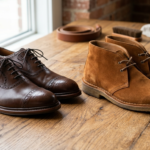
The number on your last pair of shoes is a starting point, not an answer.
That last step matters more than most men realize. Shoe sizes are not a fixed standard. They vary between brands, between regions, and even between styles from the same maker.
This guide covers how to get an accurate shoe size at home, how foot length and shoe size relate, how to read US, UK, and EU sizes, and what to do when your measurement falls between two sizes.
How to Measure Your Foot at Home
You need a sheet of paper, a pen, a ruler or tape measure, and a wall. The process takes about five minutes.

- Pick the right time. Measure in the late afternoon or evening, when feet tend to be at their largest after a day of standing and walking.
- Wear the right socks. Use the type of socks you normally wear with the shoes you plan to buy. Thin dress socks and thick cushioned socks give different results.
- Set up on a hard, flat floor. Tape a sheet of paper to the floor, with one edge flush against a wall. A carpet makes the paper shift and gives a poor reading.
- Stand with your heel against the wall. Keep your weight evenly on both feet. Measuring while seated gives a shorter reading because your foot lengthens and flattens under load.
- Mark the longest point. Have someone mark the tip of your longest toe, or lean down carefully and do it yourself. Your longest toe is usually the big toe, but for some men it is the second.
- Measure the distance. Use a ruler to measure from the paper’s edge to the mark, in centimeters or inches. Millimeters are more precise.
- Repeat with the other foot. It is common for one foot to be slightly longer than the other. Use the larger measurement.
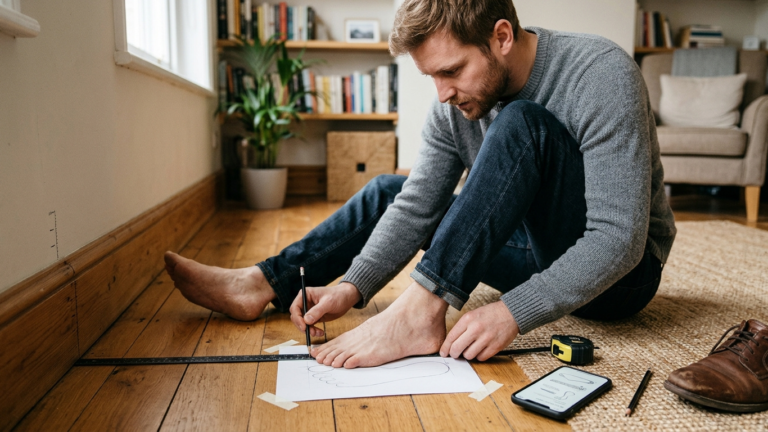
For better accuracy, you can also trace the outline of each foot and measure the longest straight line, from the back of the heel to the tip of the longest toe. Keep the pen upright and close to the foot so the outline does not drift outward.
Measure width too
Length is only half the story. Width is measured across the ball of the foot, the widest part just behind your toes.
Wrap a flexible tape measure around it or measure the traced outline’s widest point. Many brands label width with letters.
In US men’s sizing, D is generally standard (medium), E and EE are wider, and B is narrower. These categories are relative to length, so a size 12 D is wider than a size 8 D.
Read also: How Should Shoes Fit? A Practical Guide for Men
Foot Length and Shoe Size: Why They Are Not the Same Number
Your foot length is the physical distance you just measured. Your shoe size is a label attached to a shoe that was built with extra room for your toes and for comfortable movement. Those two numbers will never match exactly.
A shoe’s internal length is longer than your foot, typically by about a thumb’s width (roughly 10 to 15 mm) at the front.
That allowance exists because your foot moves forward and expands slightly when you walk. For a closer look at toe room, see our guide on.
This is also why brand size charts disagree. Two published men’s charts can list very different foot lengths for the same US size, because some charts show the foot length the size is intended to fit, and others build in the toe allowance.
Several brands explicitly warn that the centimeter figure printed on a shoe box or tongue tag is not the same as your foot length. A “27 cm” label on a shoe describes the shoe, not your foot.
The takeaway is simple: always compare your foot measurement to the specific brand’s chart, and read the notes on that chart to see what its numbers represent.
Understanding US, UK, and EU Shoe Sizes
If you buy from international brands or online stores, you will see three main systems.
- US sizes are based on foot length in inches, with separate scales for men, women, and children. A US men’s size is not the same as a US women’s size.
- UK sizes use a similar approach with a slightly different starting point, so a UK size is smaller than the US number for the same foot.
- EU sizes use the Paris point system, which is based on the length of the shoe’s last, the foot-shaped mold it is built on, in two-thirds-of-a-centimeter units.
Many brands also list a Japan or “CM” size, which is based on centimeters. The following table shows typical men’s conversions. Treat it as approximate, since brands vary.
| US men’s | UK | EU |
|---|---|---|
| 7 | 6 | 40 |
| 8 | 7 | 41 |
| 9 | 8 | 42 |
| 10 | 9 | 43 |
| 11 | 10 | 44 |
| 12 | 11 | 45 to 46 |
| 13 | 12 | 47 |
A useful rule of thumb for men’s shoes is that the UK size is usually about one size below the US size. EU sizes jump in larger steps, so some brands use half or two-thirds sizes in between, and charts do not always agree on the larger sizes.
Because of those inconsistencies, use these conversions to get a rough idea only. For an actual purchase, go by foot length and the brand’s own chart.
Read also: How to Choose the Right Shoes: A Practical Buying Guide for Men
What to Do If You Are Between Sizes
Landing between two sizes is common. A few guidelines help:
- Check which foot is larger, and size to that one.
- Consider width. If the foot is wide or thick, a larger size or a wider fitting may suit it better. If the foot is narrow, the smaller size, possibly with a snugger lacing, might be better.
- Think about the shoe type. Athletic and casual shoes generally allow more toe room and some stretch in the upper. Structured leather dress shoes have less give, so going too small is riskier.
- Follow the brand’s advice. Some brands recommend rounding up when you fall between sizes. Others suggest the opposite for certain styles. Check the specific guidance.
- Use socks and insoles wisely. Thicker socks or an insole can fine-tune volume, but they should not be used to rescue a shoe that is the wrong length.
Avoid compensating for a tight width by going up a full length. This often creates heel slippage and a foot that slides forward, which are problems of their own.
Why Your Size May Not Be the Same Everywhere
Different brands, lasts, and styles
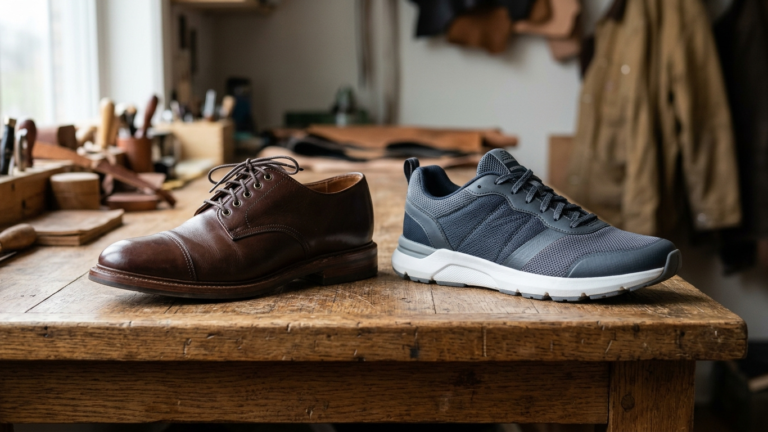
Each manufacturer builds shoes on its own lasts, and the same size can fit differently across styles. A pointed dress shoe, a roomy sneaker, and a work boot labeled 10 may all feel different. This is normal, and it is the main reason experienced buyers check the fit rather than relying on the label.
Feet change over time
Feet can lengthen and widen with age, weight changes, injury, or conditions such as fallen arches developing over time. Measuring just once in your teens and assuming it never changes is a common mistake. Re-measure every year or two, and any time your usual size starts to feel off.
Both feet are rarely identical
A small difference between left and right is normal. If the difference is large, or if one foot has changed noticeably, it may be worth seeing a podiatrist.
How to Confirm Your Size When Buying Shoes
In a store
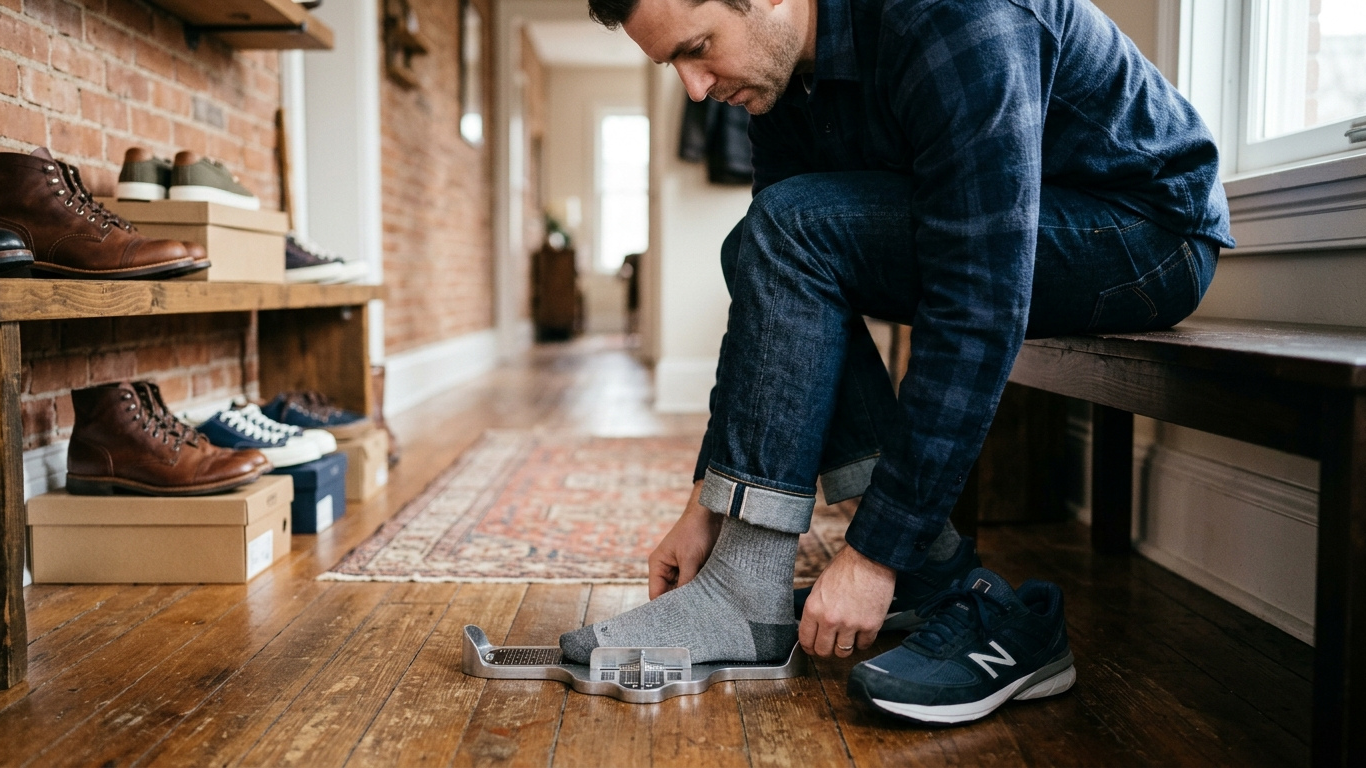
Try both shoes on, with your usual socks, in the afternoon. Stand, lace them fully, and walk around for several minutes. You are looking for roughly a thumb’s width of space past the longest toe, a heel that stays put, and no pinching across the ball of the foot or on the sides of the toes. If you want a professional measurement, many specialty stores use a Brannock device, a metal measuring tool that checks heel-to-toe length, arch length, and width.
Online
Measure first and have the measurement ready. Then:
- Find the brand’s size chart for that specific shoe, not a generic conversion.
- Match your larger foot’s length to the chart, noting whether the figures refer to foot length or shoe length.
- Check the width options.
- Read the product’s customer fit comments for guidance such as “runs small” or “runs narrow,” keeping in mind that individual feet differ.
- Confirm the return or exchange policy, and keep tags and packaging intact while you test the shoes indoors on a clean surface.
For more on shopping from home, see [internal link: how to choose the right shoe size online].
Common Shoe Sizing Mistakes to Avoid
- Trusting an old size. Your feet may have changed.
- Measuring in the morning. You may end up with a size that feels tight later in the day.
- Measuring one foot only. Always check both.
- Measuring while sitting. Your standing foot is longer and wider.
- Ignoring width. A correct length in the wrong width still hurts.
- Treating the conversion chart as exact. Use brand charts first.
- Confusing foot length with shoe length. The “CM” on the box is not your foot measurement.
- Counting on break-in time. A shoe that is clearly too small or too narrow is unlikely to become comfortable. See [internal link: how to break in leather shoes] for what is reasonable to expect.
When to See a Specialist
Most men can find their size with the steps above. But if you have persistent pain, numbness, bunions, hammertoes, flat feet, high arches, diabetes, or circulation problems, a podiatrist or an experienced shoe fitter can help. They can assess your foot shape, recommend appropriate widths and styles, and advise on whether orthotics make sense for you.
Final Takeaways
Your correct shoe size is the one that fits your larger foot with about a thumb’s width of space at the front, matches your width, and holds your heel securely.
Measure both feet while standing, in the late afternoon. Compare your measurement with each brand’s own chart.
Remember that US, UK, and EU numbers are approximate conversions, and that the measurement on a shoe box describes the shoe, not your foot.
When you are unsure, trust the try-on. A shoe that feels comfortable and secure from the first wear is a better indicator than any number.
Read also: