How Should Shoes Fit? A Practical Guide for Men
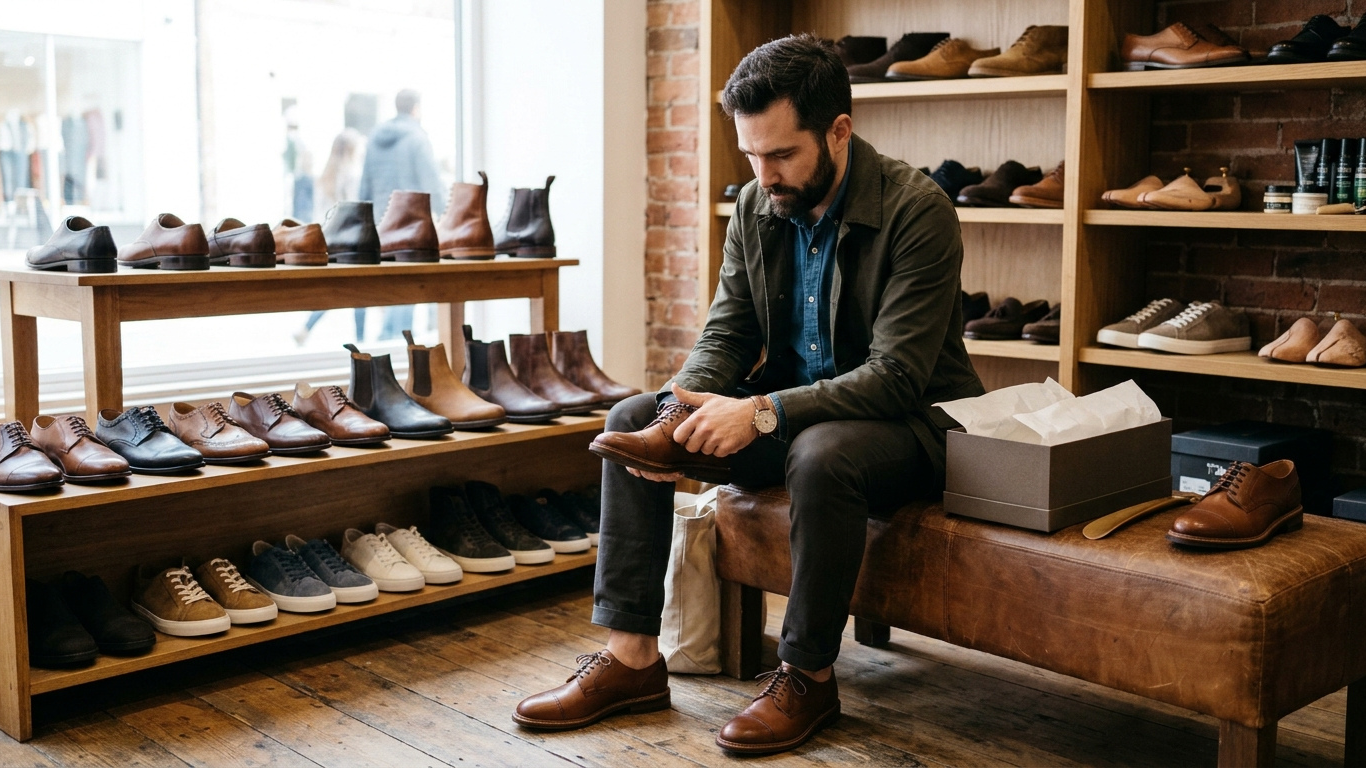
Shoes should fit snugly around your heel and midfoot, with about a thumb’s width (roughly 10 to 15 mm, or 3/8 to 1/2 inch) of space between your longest toe and the front of the shoe.
The widest part of your foot should sit in the widest part of the shoe, your toes should lie flat without touching the top, and your heel should stay put when you walk.
If the shoe passes those checks the moment you put it on, you have found proper shoe fit.
That sounds simple, but most men buy shoes by the number on the box, and that number is the least reliable part of the process. Sizes vary between brands, between styles from the same brand, and even between a left and right foot.
This guide explains how much room should be in shoes, how to test fit in the store, and how to spot the signs that a pair is too small or too big.
The Short Answer: What Proper Shoe Fit Looks Like
Use this five-point check on every pair, standing up and wearing the socks you plan to use:

- Length: About a thumb’s width between your longest toe and the end of the shoe. Your longest toe is not always the big toe, so check both.
- Width: The ball of your foot (the broad area just behind your toes) should sit in the widest part of the shoe. The upper should not bulge, and your foot should not spill over the edge of the sole.
- Toe box height: Your toes should lie flat and be able to wiggle, with nothing pressing on the tops of them.
- Heel: The heel should be held firmly. A small amount of lift in a stiff new leather shoe is normal, but your heel should not slide up and down as you walk.
- Midfoot: The laces or fastening should hold your foot snugly without pressure points, numbness, or a feeling of strangulation across the top of the foot.
If any of the five fails, the shoe is not right for you, no matter what the label says.
How Much Room Should Be in Shoes?
Length: the thumb’s width rule
Podiatry organizations and foot clinics commonly recommend leaving about a thumb’s width, or 10 to 15 mm, between the tip of your longest toe and the front of the shoe.
The gap exists because your foot lengthens and spreads slightly under load. When you stand and walk, your foot moves forward in the shoe, and without that buffer your toes jam against the front.
To check it correctly:
- Stand up. A seated foot is shorter and flatter than a loaded one.
- Press your thumb down on the shoe’s end, just beyond your longest toe.
- If you can only feel your toe, the shoe is too short. If you can fit well over a thumb and a half, it is likely too long.
Width: snug, not squeezed
Width is measured across the ball of the foot, not at the toe tip. A good fit feels secure across the ball and instep without pinching.
If the leather or mesh bulges outward at the sides, or your little toe feels pushed inward, you need a wider fitting or a different last (the foot-shaped mold a shoe is built around).
Many brands sell the same style in standard (often labeled D) and wide (E or EE) widths. Moving up a full length to get more width is a common mistake, and it usually creates new problems, which are covered below.
Depth and toe box: the overlooked dimension
Toe box depth is the vertical space above your toes. If your toes brush the top of the shoe, you can get rubbing, corns, and sore nails even when length and width seem fine.
Men with hammertoes, bunions, or high-volume feet should pay special attention here. A rounder or squarer toe shape generally gives more room than a sharply tapered one.
Read also: How to Choose the Right Shoes: A Practical Buying Guide for Men
When and How to Try Shoes On
Shop in the afternoon
Feet tend to swell over the course of the day from standing, walking, and heat. Estimates of how much vary by source and by person, so treat any specific figure with caution, but the practical advice is consistent: try on shoes in the late afternoon or evening, when your feet are at their largest. A pair that fits at 9 a.m. may feel tight by 4 p.m.
Follow a simple in-store routine
- Wear the socks you will actually use with the shoes. Thin dress socks and thick cushioned socks change the fit noticeably.
- Try on both shoes. Most people have one foot slightly larger than the other, and you should fit the larger one.
- Lace the shoes fully, using every eyelet. Loose or half-laced shoes make almost any size feel acceptable.
- Stand, then walk around the store for at least several minutes. Climb a stair or a ramp if possible, since this exposes heel slip.
- Notice pressure points, especially at the sides of the big toe and little toe, the top of the foot, and the back of the heel.
Do not count on “breaking them in”
Some break-in is normal for stiff leather shoes. Sharp pressure, pinching, or toes pressed against the front is not. Shoes that are the right size for your foot should feel basically comfortable from the first wear, with only mild stiffness that eases.
Buying a shoe that is clearly too tight in the hope it will stretch is a reliable way to end up with blisters and a pair you never wear.
Signs Your Shoes Are Too Small
A shoe that is too short, too narrow, or too shallow often shows its problems quickly. Watch for these:
- Toes touching the front when you stand, or no visible gap past your longest toe.
- Toe cramping or curling, where your toes feel stacked or have to grip to stay comfortable.
- Bulging at the sides, where the upper stretches tight over the ball of the foot or your foot overhangs the sole.
- Blisters or sore spots on the sides of the feet, the tops of the toes, or the back of the heel.
- Red marks or deep sock-line impressions on your feet after wearing them.
- Numbness, tingling, or burning in the toes or forefoot, which can indicate pressure on nerves.
- Darkened or bruised toenails, a common result of repeated impact against the front of the shoe, especially in running and hiking.
- Pain on the ball of the foot or the side of the big toe joint.
Persistent tight shoes are also associated with corns, calluses, and aggravated bunions and hammertoes. If you have numbness, a toenail injury, or ongoing foot pain, see a podiatrist rather than just trying a new size.
Signs Your Shoes Are Too Big
Oversized shoes are less obviously uncomfortable at first, which is why many men wear them for years. They cause problems because your foot moves around inside, creating friction and forcing you to compensate.
- Heel slipping up and down with each step, which causes blisters and rubbing at the back of the heel.
- Your foot sliding forward on downhill slopes or stairs, jamming your toes into the front.
- Creasing in the wrong place. Leather shoes should crease near the ball of the foot where you bend. Deep creases far back toward the midfoot, or a shoe that folds awkwardly, suggest it is too long or not sitting right.
- Needing to over-tighten the laces to keep the shoe on, which can create pressure across the top of the foot.
- Curling your toes to grip the shoe or keep it from slipping off, a habit that can lead to tired feet and toe problems.
- More than about a thumb and a half of empty space at the front.
- A loose, flapping feeling around the midfoot even when fully laced.
A shoe that is wide enough but too long often feels fine standing still and falls apart once you start walking, so always test it in motion.
Why Going Up a Full Size Rarely Fixes the Problem
When a shoe feels tight, the instinct is to size up. That helps if length is the issue, but it often backfires when the real problem is width or volume.
A longer shoe still pinches across the ball of the foot, and now your heel also slips and your foot slides forward.
The better move is to try a wider fitting, a different last, or a different brand, rather than assuming bigger is better.
The opposite also applies. Going down to fix a loose heel can crush your toes. If the heel is the only issue, heel grips, a tongue pad, or a different lacing method can help.
If the problem is general looseness, you probably need a smaller size or a better-matched shoe.
Fit Differs by Shoe Type
The thumb’s width rule is a solid baseline, but different shoes behave differently.
| Shoe type | What to expect from a good fit |
|---|---|
| Sneakers and running shoes | A thumb’s width at the front is especially important because feet expand and slide forward during impact. A secure heel and midfoot with a roomy toe box. |
| Leather dress shoes (Oxfords, Derbies) | Often slightly snugger through the heel and midfoot. Toe room can look smaller because of a tapered toe shape, but your toes should still lie flat without pressure. Leather softens a little with wear, but not enough to fix a poor fit. |
| Boots | Your heel will lift slightly in new, stiff boots, but it should not slide excessively. Boots are often worn with thicker socks, so try them with those. Allow toe room for downhill walking in hiking boots. |
| Loafers | Because there are no laces to adjust, the heel and midfoot must hold the shoe on securely. Loose loafers slip off, and tight ones pinch. |
| Sandals | Your heel should sit fully on the footbed, and toes should not hang over the front edge. |
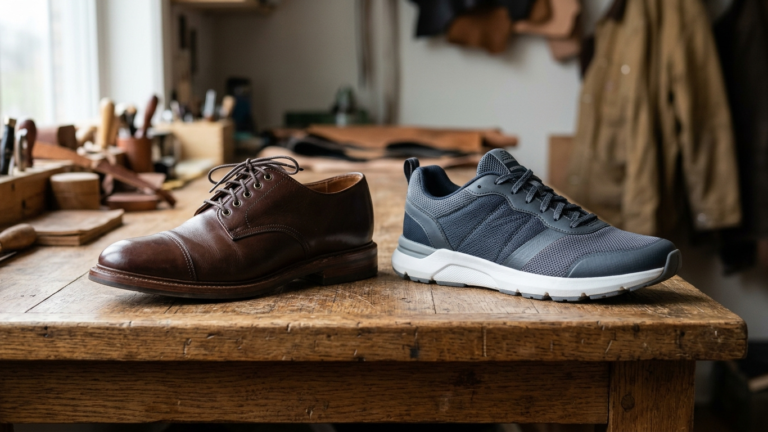
Brands also size differently. A 10 in one maker’s sneaker can match a 9.5 or 10.5 in another brand’s dress shoe. Trust the fit, not the number.
Common Fit Mistakes to Avoid
- Buying only by size. Use size as a starting point, then judge the fit.
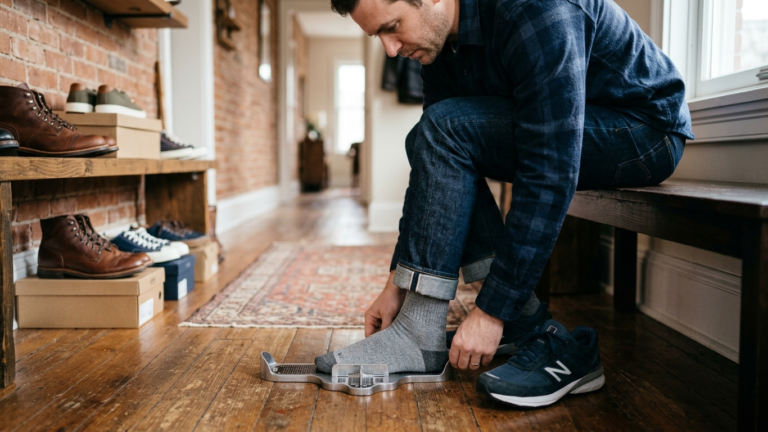
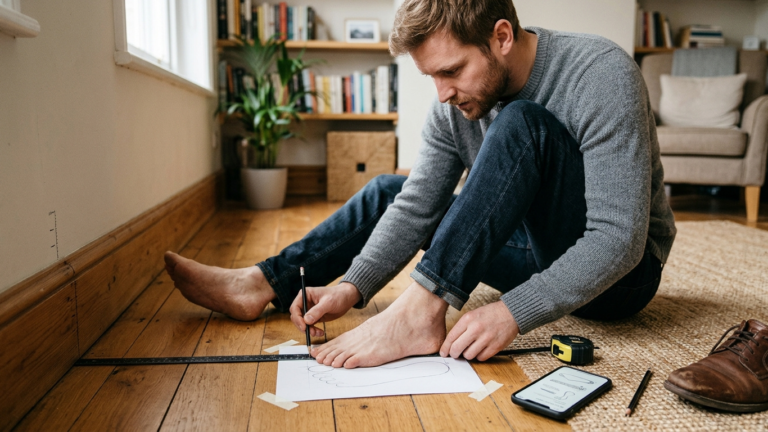
- Measuring once and never again. Feet can lengthen and widen with age, weight changes, and injury, so remeasure periodically. Using a Brannock device or having a store measure both feet is a good habit.
- Ignoring the smaller details. Check width, depth, and heel hold, not just toe room.
- Trying shoes on in the morning or while rushed. You will not notice problems that appear after a few minutes of walking.
- Wearing the wrong socks to the fitting. The socks change the volume in the shoe.
- Fitting the smaller foot. Always fit the larger foot.
- Keeping shoes that hurt because of the price or a return window you let lapse. Pain is a reason to return them.
What to Do If Your Feet Do Not Fit Standard Shoes
Some men struggle to find a good fit in standard shoes. If you have wide feet, high arches, flat feet, bunions, or a noticeable size difference between your feet, a few options can help:
- Look for brands that offer multiple widths and different lasts.
- Choose shoes with adjustable fastenings, such as laces, which let you tune the fit across the foot.
- Use insoles, padding, or heel grips to fine-tune volume, but only to adjust a shoe that already fits reasonably well, not to rescue one that does not.
- Visit a specialty footwear store or a podiatrist for professional fitting, especially if you have diabetes, circulation problems, or ongoing foot pain. These conditions make poorly fitting shoes a more serious risk.
Final Takeaways
Good fit comes down to a few checks you can do in two minutes: a thumb’s width of space past your longest toe, a ball of the foot that sits in the widest part of the shoe, toes that lie flat, and a heel that stays put.
Shop later in the day, wear your usual socks, try both shoes, and walk before you buy.
If a shoe is too small, you will feel it in cramped toes, pressure points, and sore nails.
If it is too big, you will feel it in a slipping heel, a foot that slides forward, and extra friction. Neither should be accepted as normal, and neither will reliably fix itself with time.
When in doubt, choose the pair that feels comfortable and secure the moment you put it on.
Read also: